She Limped for 24 Years: An African Grey's Crooked Leg, Solved by X-Ray
A 24-year-old African Grey had limped her whole life. In an online consultation her X-rays revealed an old hip dislocation — why surgery was the wrong answer, and how we protect her instead.
.jpg)
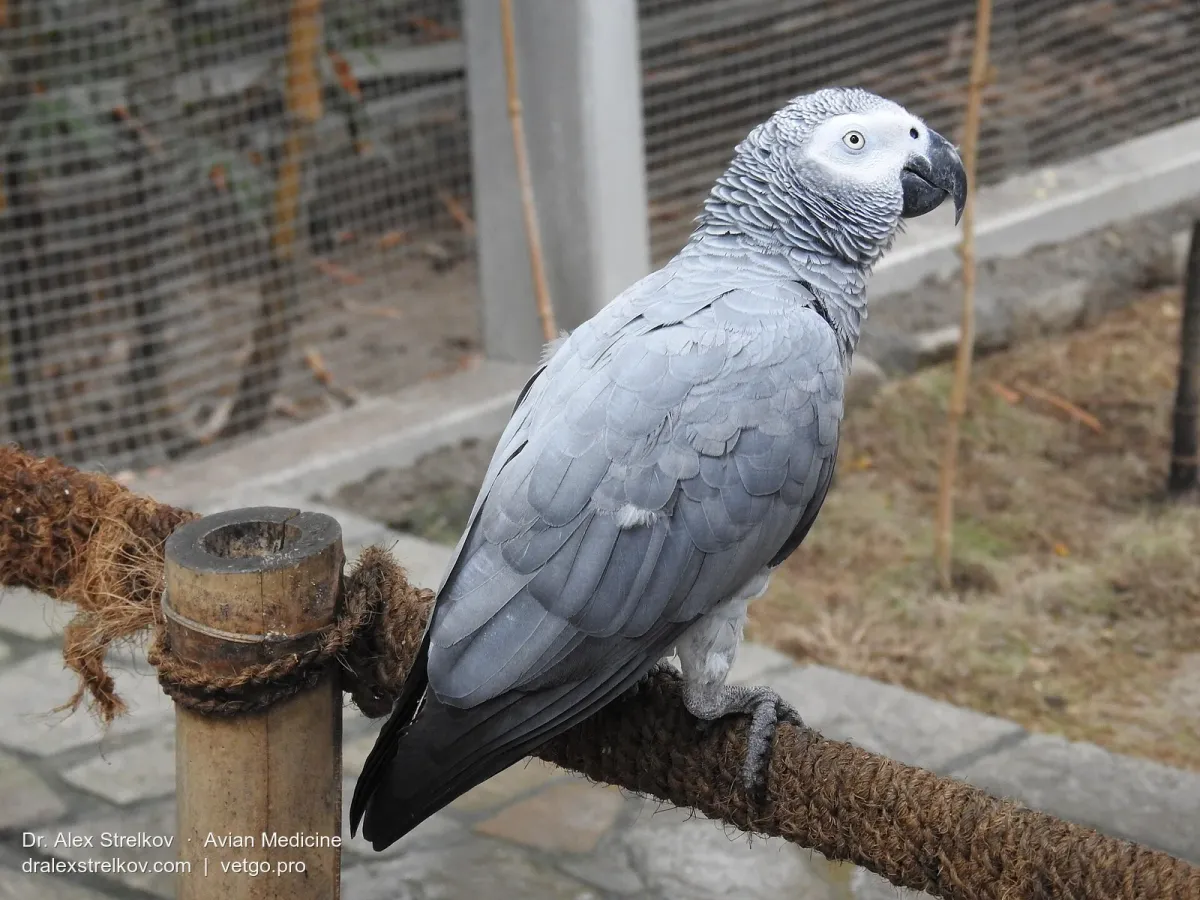
Some birds arrive in my virtual consulting room in a sudden crisis. Jaco arrived with a mystery she had been carrying her entire life.
She is a 24-year-old African Grey — bright, talkative, and by every account a delight to live with. Yet for as long as her family can remember, she has favored one foot. She walks, she climbs, she plays. She simply does all of it with a limp that never quite goes away. Her people had long ago made peace with it. What they wanted, at last, was an honest answer: Is she in pain? Is it getting worse? Did we miss something all these years?
They sent me a set of radiographs and booked an online avian vet consultation — essentially a second opinion on a bird nobody had ever fully explained to them. This is what the X-rays told us, and why the right treatment turned out to be the one that involves no surgery at all.
A Bird Who Was Simply Born a Little Crooked
Almost everything about Jaco's daily life is textbook-normal. Good appetite. Curious and active. Out of the cage whenever she pleases. Her only other long-standing quirks are droppings that occasionally turn loose before settling again, and a history of aspergillosis that is currently in remission — both worth quietly watching, but neither is the reason she limps.
The limp is a different kind of clue. It has been there since she was young: steady, unchanging, part of who she is. In medicine, how a problem behaves over time often tells you more than the problem itself. A limp that appears overnight shouts injury or infection. A limp that has been part of a bird for two decades whispers something calmer: this is how her body was built, or how it healed a very long time ago.
What a Parrot's Hip Should Look Like — and What Hers Didn't
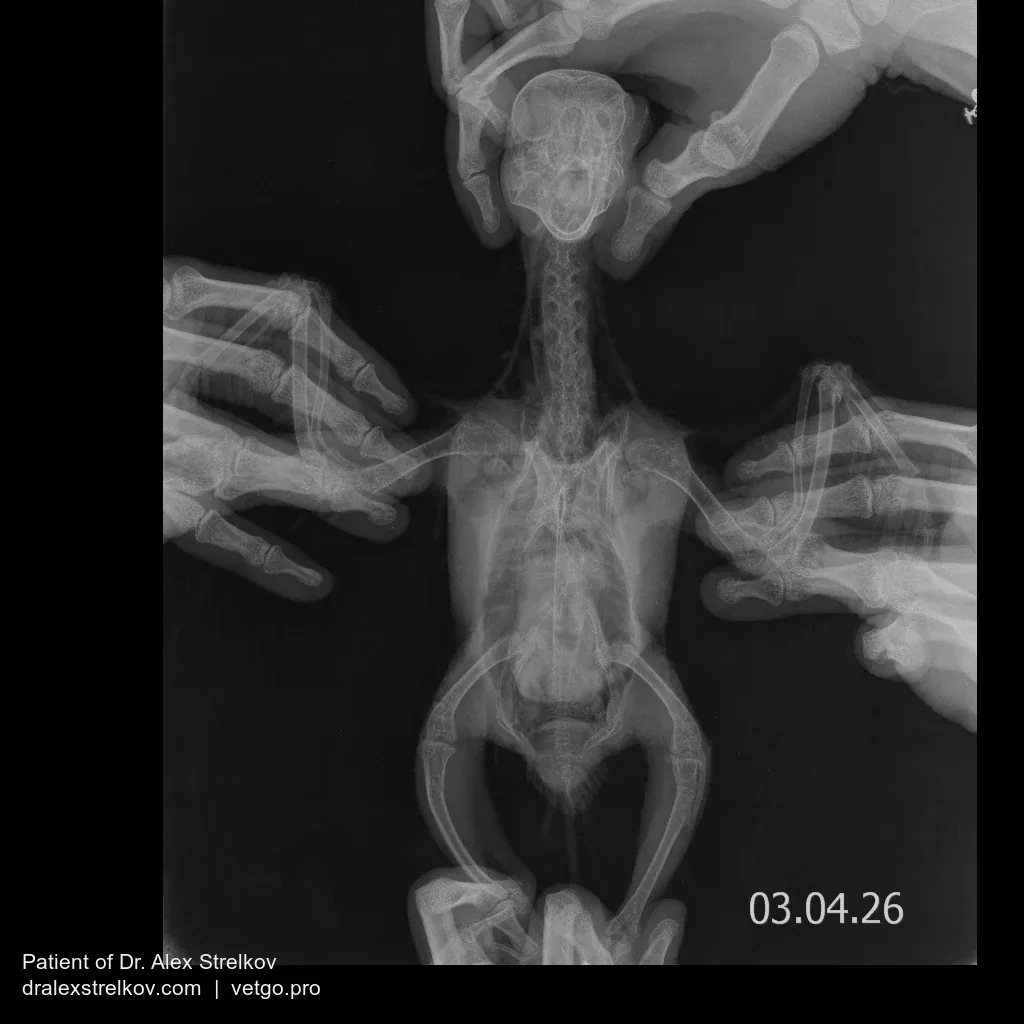
To understand a bird's leg, you first have to see the whole bird. On the ventrodorsal view — Jaco lying gently on her back with her wings and legs extended — the asymmetry becomes visible even to an untrained eye once you know where to look. One hip sits roughly where it belongs. The other clearly does not. This is exactly the kind of question a general small-animal clinic is rarely equipped to answer, and it is a big part of why avian vets are so hard to find.
Reading the Bones: An Old Injury, Frozen in Place
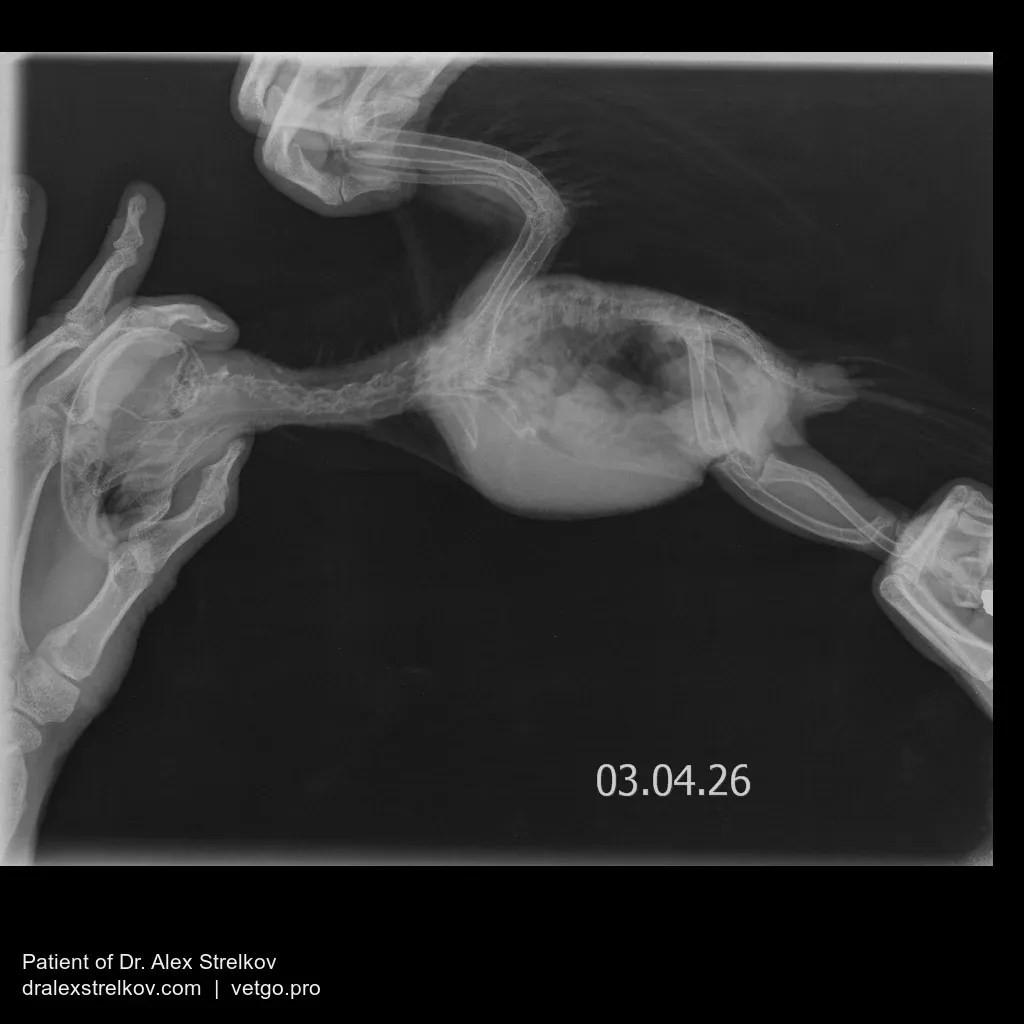
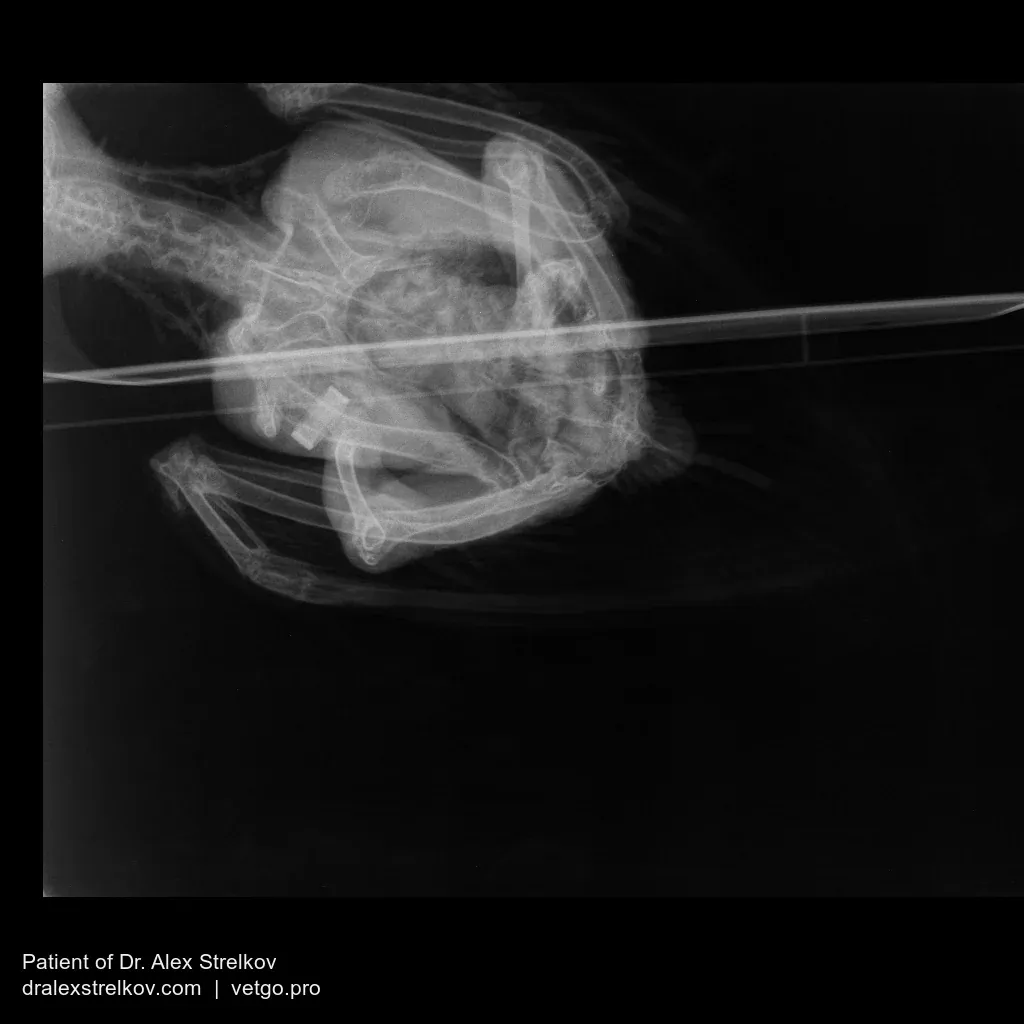
On the close view of the left hip, the joint is deformed and the surrounding bone is heavily remodeled — reshaped, thickened, and locked into a position it was never designed to hold. That is the unmistakable signature of a chronic, long-standing subluxation or luxation: a partial or complete dislocation of the hip that happened long ago and has since set like concrete.
What the X-rays don't show matters just as much. There is no sign of a fresh fracture and no sign of recent trauma. Whatever happened to this leg happened years ago. The bone has already finished its healing — for better and for worse.
So where did it come from? The two likeliest explanations are a congenital anomaly — she may well have hatched this way — or an injury during her rapid growth as a chick, when young bones are soft and forgiving right up until, suddenly, they aren't. We may never know which. And for the plan going forward, it honestly doesn't change a thing.
Why I Deliberately Chose Not to Operate
The instinct, when we see a crooked bone, is to want to straighten it. Surgically, that would mean an osteotomy: deliberately cutting and re-breaking the bone to realign it. On a fresh injury in a young bird, that can absolutely be the right call. On a 24-year-old deformity that has fully remodeled — and that its owner has completely adapted to — it is a very different story. The surgery is difficult, genuinely traumatic, and frequently does more harm than the problem it sets out to fix.
Jaco does not need a new leg. She has spent 24 years becoming a world expert on the one she has. My job is not to fix what she solved as a chick — it is to protect the rest of her from the hidden cost of that solution.
The Real Threat Isn't the Bad Leg — It's the Good One
Here is the part that surprises almost every owner. The biggest long-term risk to a bird like Jaco is not the deformed hip at all. It is the healthy leg, quietly overworking to compensate, day after day, year after year. That relentless overload wears down cartilage and joints faster than nature intended and invites secondary osteoarthritis — and it puts the sole of the good foot at risk of pressure sores (pododermatitis), a painful and stubborn problem once it takes hold.
Everything that follows is aimed at one simple goal: take the load off the good leg, and keep the good leg healthy.
The Home Setup That Quietly Does the Real Treatment
For a case like this, the cage is the clinic. Three changes carry almost all of the benefit:
- Guard her weight. Every extra gram is extra load on joints that are already negotiating a bad deal. Keeping her lean is one of the most powerful — and most underrated — treatments I can offer her.
- Rethink the perches. Identical round dowels force her feet into the very same grip all day long. Replace them with natural branches of varying, uneven diameter, along with a few wide, stable platforms. Different shapes let her constantly shift her grip and redistribute the pressure — a kind of physical therapy she gives herself, for free, all day.
- Inspect both soles regularly. If you ever spot redness, callousing, or smooth shiny patches on the healthy foot, that is your early warning. Add soft, stable, non-slip platforms that are easy to keep clean, and don't wait for it to worsen.
If your own bird's cage is built around a row of matching round perches — the factory default in most cages sold today — that alone is worth changing this week, whether or not your bird has ever limped.
A Photograph Every Six Months: How We Watch This Over Time
An old, remodeled bone is stable, but it is not something we simply forget about. Chronically altered bone earns a place on our watch-list, because long-standing changes can — rarely — begin to transform, and catching that early can change everything.
So we set a rhythm. A follow-up X-ray in about six months (for Jaco, late 2026), another the following summer of 2027, and if the area stays quiet, we ease back to once a year after that. For these images to be worth anything, the small details matter: the same clinic, the same positioning, and ideally the same vet, so every picture can be compared honestly against the last. We always take two views — a whole-body shot on her back that includes the pelvis and air sacs, and a side view of the left leg — and we make sure no hand or restraint ever covers the exact area we're trying to see.
When Not to Wait for the Next Check-Up
Book an earlier visit if the limp suddenly worsens, if she stops bearing weight on the leg altogether, or if you notice new swelling, tenderness, a dip in her usual energy, falls from the perch, or clear signs that the good leg is being overworked. Those are the moments when a tidy six-month schedule simply isn't fast enough.
Thriving on Three Good Decades and One Stubborn Leg
Jaco's story was never really about a broken bird. It is about a bird who quietly overcame something at the very start of her life and has been flourishing ever since — and about an owner whose real question wasn't "how do we fix her?" but "how do we take the best possible care of her?" That is exactly the right question to ask. Sometimes the finest medicine on offer is an accurate diagnosis, a calm plan, and the genuine reassurance that you have been doing right by your bird all along.
If your parrot limps, tilts, favors one foot, or has a quirk you have simply learned to live with, it is worth having a proper look — and often that look can happen without either of you leaving home, even if there is no avian vet near you. Send me your photos, videos, or X-rays, and we will go through them together.